
Continental rifts losing driving forces can still complete breakup
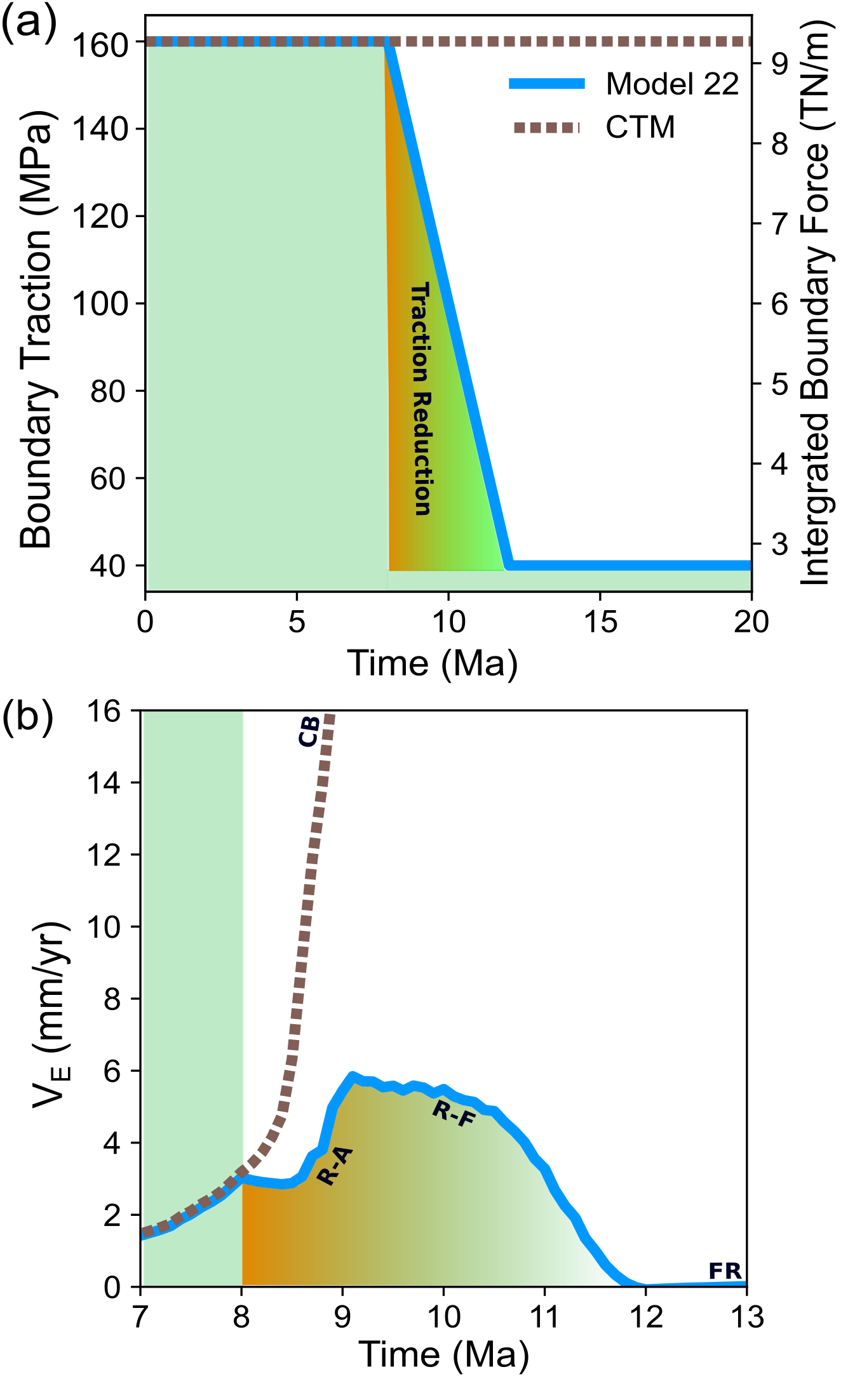
In this project,we investigated how temporally varying driving forces—such as those arising from changes in slab dynamics—affect rift evolution using numerical and semi-analytical models. Our results show that the timing, duration, and magnitude of boundary traction reductions strongly influence rift behavior. Later initiation of traction reduction and slower rates of reduction tend to promote successful continental breakup. Even a 25% decrease in boundary traction can lead to breakup under favorable conditions, while a 50% reduction often results in failed rifts. Interestingly, extension velocities do not always evolve monotonically; temporary accelerations can occur during force reduction, reflecting the dynamic nature of force balance. As shown in (b) both rift acceleration (R-A) and rif failure (R-F) could occur during force reduction (75%) period. Our findings highlight that a rift can accelerate toward breakup even during periods of slow extension, demonstrating that variations in driving forces play a critical role in determining whether continental rifting succeeds or fails. Manuscript is accepted in Scientific Reports.
The Role of Mantle Plumes in Reactivating Rifts under Unfavorable Tectonic Conditions
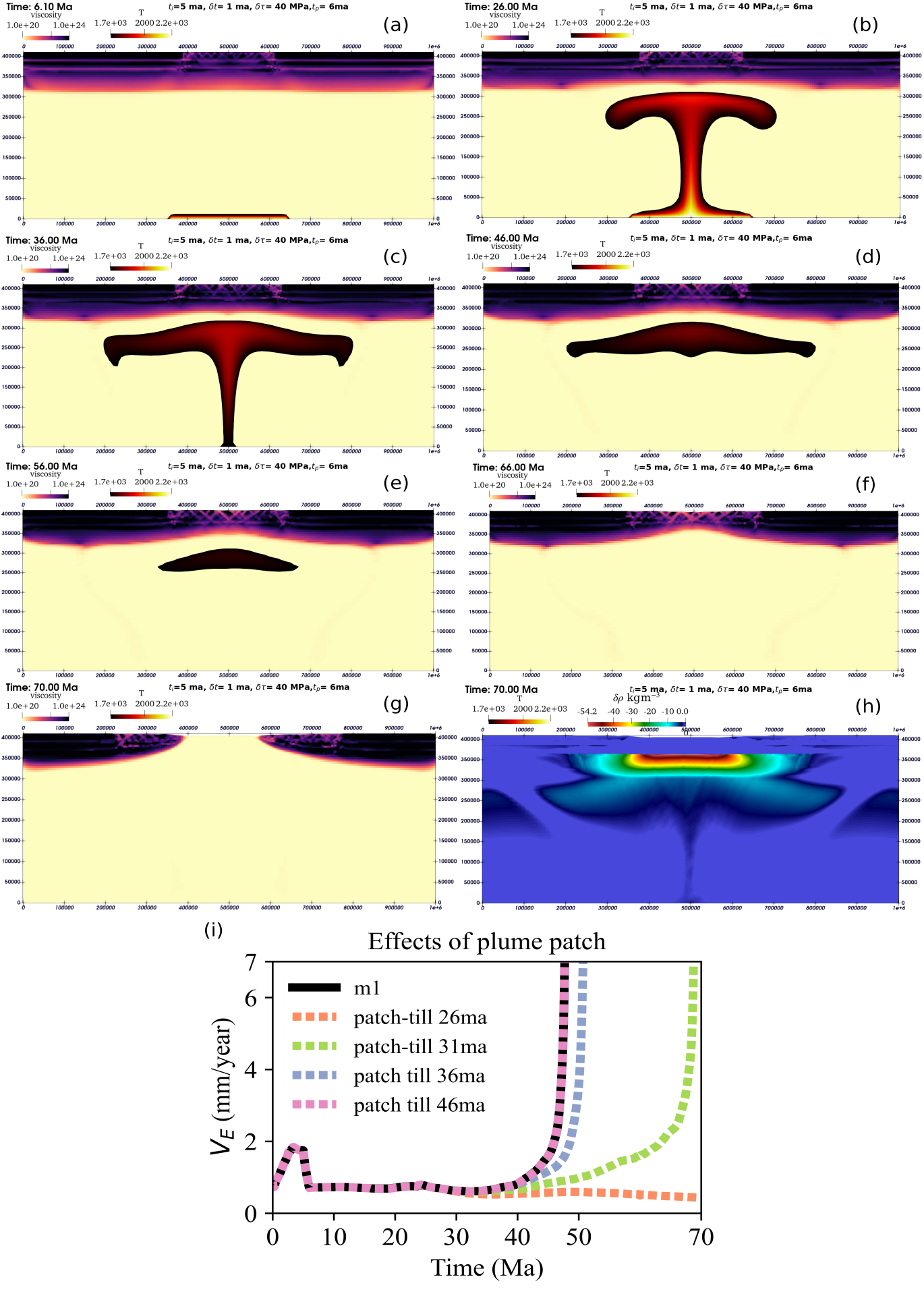
In this project we investigate under what conditions that a late arriving mantle plume can reactivate a failed continental rift system. We construct 2D numerical models to intiate continental rift system which intially developed under constant traction, went through a reduction in driving force (δτ=40,80,120 MPa), end up as a failed rift system. Then at the end of force reduction period (δt=1,2, and 4 ma), we introduce a plume as heat patch at bottom boudanry, centering the weak zone to evaluate the effect of plumes’buoyancy reactivating the rift system. The figure illustrate one scenario, where we systematically remove the heating patch, to study the plumes’ ability to weaken the lithospehre, while loosing it’s buoyancy due to heat diffusuion. (a-g) visualize the shape change of plume, indicating Initial temperature field inside the plume completely diffuse to surrounding mantle,remaining density anomaly {figure (h)} just enough to drive the system toward continental breakup. Effects of duration of heat patch on rifting speed shown in figure (i){a-h indicate model evolution for light green line}. Manuscript in preperation.
Plume-Driven Asymmetry and the Emergence of Failed Rifts Under Ridge Push forces
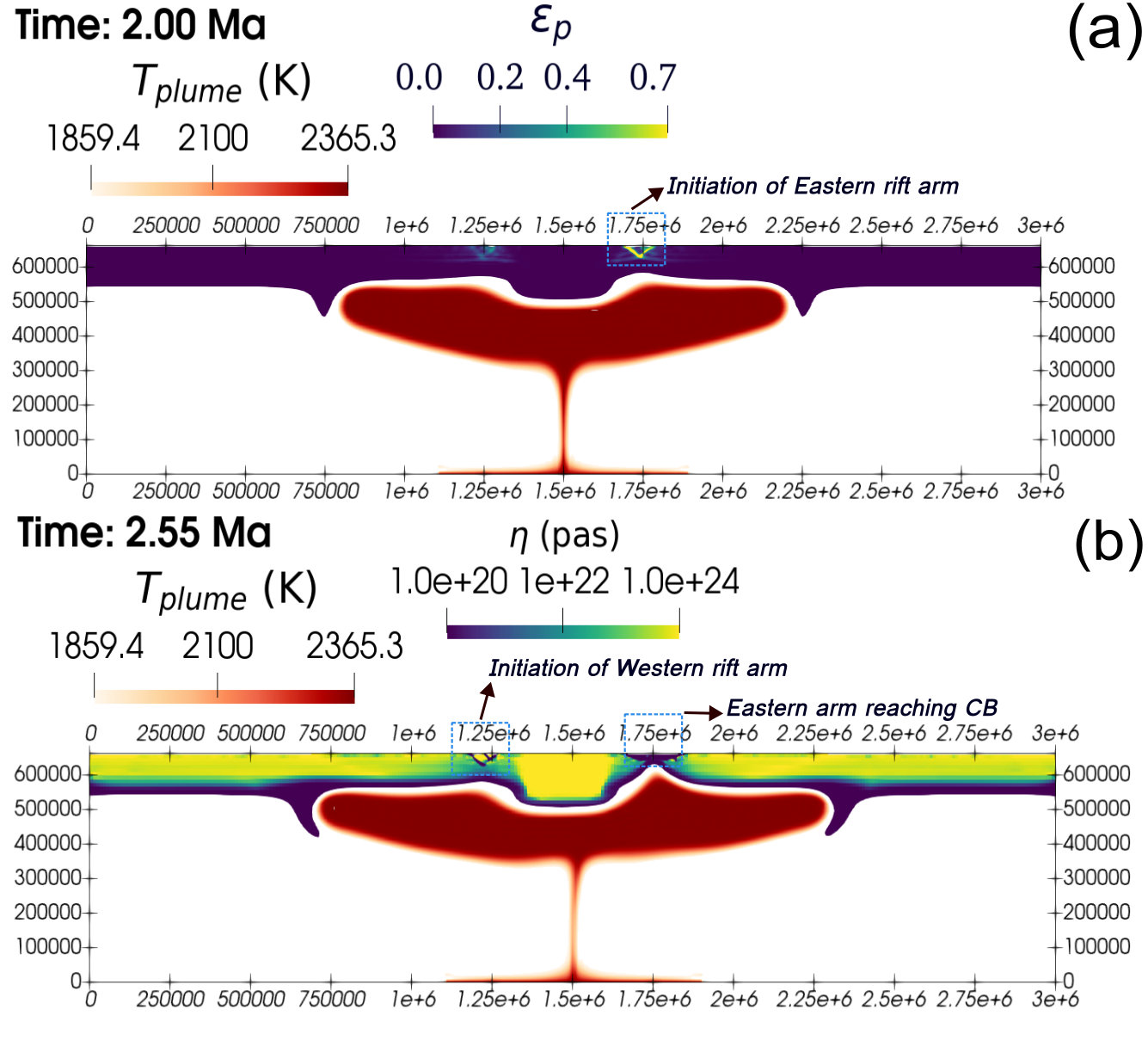
The East African Rift System provides a unique tectonic setting to investigate asthenospheric influence on continental rifting in the presence of rigde push forces. The system comprises two active rift arms-the Eastern and Western branches encircling the Tanzanian craton. The Eastern Rift initiated earlier and is more evolved, approaching continental breakup and incipient seafloor spreading, while the Western Rift remains at an earlier stage of development. We construct 2D models to constrain the mechanisms responsible for double rift development and identify the conditions under which one arm evolves into a successful rift while the other stalls or fails. Abstract submitted to AGU 2025!